
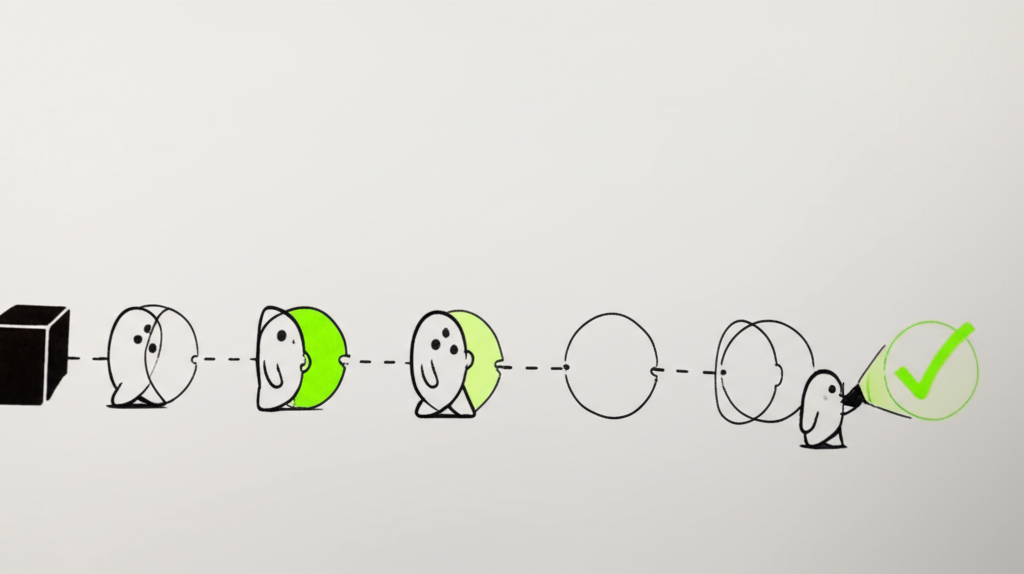
Regulators Are No Longer Asking How Your AI Works -- They Want Proof of Every Decision
In 2024, the European Union's AI Act entered into force. South Korea's AI Basic Act followed in January 2026. The United States issued Executive Order 14110 mandating AI safety standards across federal agencies. Singapore's Model AI Governance Framework has been adopted by over 60 organizations. Across every major economy, the regulatory message is converging on a single demand: show us exactly how and why your AI made each decision.
This is not a theoretical concern. In March 2023, the Dutch tax authority was forced to dismantle an automated system that had wrongly flagged over 26,000 families for childcare benefit fraud. The investigation revealed not that the algorithm was unexplainable -- researchers could describe its logic -- but that no one could reconstruct the specific chain of events that led to each individual decision. The model's behavior could be described in general terms. Individual decisions could not be verified.
That distinction -- between describing how an AI system works and proving what a specific decision was -- is the core challenge of AI decision traceability. And it is a distinction that most organizations have not yet grasped.
The Critical Risk: "We Can Explain the Model" Is Not "We Can Prove the Decision"
When regulators come knocking -- and they will -- the conversation follows a predictable pattern. The compliance team presents the model documentation: architecture diagrams, training data summaries, performance metrics, fairness assessments. The regulator nods, then asks a different question: "Show me Decision #47,291. What data went in? What governance policies were applied? Who reviewed it? Can you prove none of this was altered after the fact?"
This is where most organizations freeze. They have invested heavily in model documentation and explainability tooling. They can generate SHAP values and feature importance plots. They can describe the model's decision boundary in aggregate. But when asked to reconstruct a single decision with verifiable evidence, they discover a gap that no amount of model documentation can fill.
The risk is not abstract. Under the EU AI Act, high-risk AI systems must maintain logs capable of recording the functioning of the system to such an extent that the results are traceable. Article 12 does not say "explainable." It says "traceable." Under South Korea's AI Basic Act, operators of high-impact AI must provide "records and evidence of AI decision-making processes" upon request. Under the U.S. Executive Order, agencies must demonstrate "the provenance and lineage of AI-generated content and decisions."
Three different regulatory frameworks. Three different legal traditions. One common requirement: prove what happened, not just explain how it works.
What Happens When You Cannot Prove a Decision
The consequences of failing to provide decision-level traceability are escalating. Under the EU AI Act, non-compliance can result in fines of up to 35 million euros or 7% of global annual turnover. Under South Korea's framework, organizations face operational restrictions and potential criminal liability for senior management. In the United States, federal contractors risk losing access to government AI procurement entirely.
But regulatory fines are only part of the picture. When an AI decision is challenged in court -- a denied loan application, a rejected insurance claim, a flagged welfare recipient -- the burden of proof falls on the organization that deployed the system. If you cannot reconstruct the decision with verifiable evidence, you lose. Not because the decision was wrong, but because you cannot prove it was right.
Why Current Approaches to AI Decision Traceability Fall Short
Organizations typically rely on three approaches to address decision traceability, and each fails in a different way.
Explainable AI (XAI) Explains the Model, Not the Decision
Explainable AI tools like LIME, SHAP, and Grad-CAM have become standard in responsible AI toolkits. They serve an important purpose: helping data scientists and domain experts understand why a model behaves the way it does. SHAP values can show which features contributed most to a prediction. LIME can approximate a model's local decision boundary for a specific input.
But XAI explanations are post-hoc rationalizations, not records of what actually happened during a decision. A SHAP explanation generated after the fact tells you which features the model weighted most heavily -- but it does not tell you what governance policies were checked before the decision was executed, whether a human reviewed the output, or whether the input data was within the model's validated operating range.
More critically, XAI explanations are not immutable. You can generate a SHAP explanation today and a different one tomorrow for the same decision, depending on the background dataset used. An explanation that can change after the fact is not evidence. It is interpretation.
Application Logging Captures Events, Not Governance Context
The second common approach is to rely on application logs. Every enterprise system generates logs -- timestamps, input parameters, output values, error codes. Application logs are essential for debugging and operational monitoring. But they are structurally incapable of serving as compliance evidence for several reasons.
First, application logs capture technical events, not governance decisions. A log entry might record that a prediction was made at 14:32:07 with a confidence score of 0.87. But it does not record that the organization's governance policy required human review for any prediction in that risk category, that a qualified reviewer actually performed that review, or that the review was completed before the decision was acted upon.
Second, application logs are mutable. They are stored in databases and file systems that can be modified, truncated, or deleted. A log that can be altered after the fact cannot serve as cryptographic proof that a particular chain of events occurred.
Third, application logs lack referential integrity. Log Entry A does not cryptographically link to Log Entry B. There is no way to verify that the sequence of events recorded in the logs is complete and unaltered. An adversary -- or an honest mistake -- can insert, modify, or delete log entries without detection.
Governance Frameworks Without Enforcement Are Theater
The third approach is to establish governance frameworks: policies, procedures, committees, risk assessments. These are necessary but not sufficient. A governance framework says "high-risk decisions must be reviewed by a qualified human." But without a technical mechanism to enforce and record that requirement, the framework is a document, not a control.
Research from MIT Sloan in 2024 found that 78% of organizations with formal AI governance frameworks could not demonstrate compliance with their own policies when audited. The frameworks existed. The evidence did not.
What True AI Decision Traceability Requires
Genuine AI decision traceability is not a feature you bolt onto an existing system. It is an infrastructure capability with specific technical requirements. Understanding these requirements is the first step toward building systems that can actually satisfy regulatory demands.
Decision Capture: Recording What Actually Happened
The first requirement is comprehensive decision capture -- recording not just the model's output, but the complete decision context. This includes the input data (or a verified hash of it), the model version and configuration, any pre-processing or post-processing steps applied, and the final output delivered to the end user or downstream system.
Decision capture must happen at the time of the decision, not after the fact. Retrospective reconstruction is inherently unreliable because system state, model versions, and data availability change over time.
Context Preservation: The Governance Envelope
The second requirement is preserving the governance context that surrounded the decision. Which policies applied? What risk level was assigned? Was human oversight required, and if so, was it performed? What was the reviewer's assessment? Were any override conditions triggered?
This is what separates decision traceability from logging. A log records that something happened. Context preservation records why it was allowed to happen -- the governance rationale that authorized the decision to proceed.
Integrity Proof: Cryptographic Verification
The third requirement is cryptographic integrity -- proof that the recorded decision and its context have not been altered since capture. This requires more than a database with access controls. It requires a mechanism where each decision record is cryptographically linked to the previous one, creating an append-only chain where any modification to a historical record is mathematically detectable.
This is the concept of decision provenance as distinct from decision explanation. Explanation tells you why a model made a choice. Provenance proves that a specific sequence of events -- input, governance check, human review, output -- actually occurred in a specific order and has not been tampered with.
Governance Verification: Proving Policy Compliance
The fourth requirement is governance verification -- not just recording that policies existed, but proving that they were actually applied to each decision. This requires a machine-readable governance specification that can be automatically checked against each decision record.
A governance policy that says "clinical AI decisions require physician review" must be translated into a verifiable check: was the decision flagged for review? Was a review assigned? Did a qualified reviewer complete the review? Was the review completed before the decision was acted upon? Each of these steps must be independently verifiable.
Regulatory Export: Standards-Based Evidence
The fifth requirement is regulatory export -- the ability to produce decision records in standardized, machine-readable formats that regulators can independently verify. This means structured data with well-defined schemas, not PDF reports or PowerPoint presentations. Regulators are building their own verification tools, and they need data they can actually process.
Decision Provenance vs. Decision Explanation: The Critical Distinction
The concept that ties these requirements together is decision provenance. Just as data provenance tracks where data came from and how it was transformed, decision provenance tracks where a decision came from -- what inputs, what model, what governance, what human oversight -- and proves that this lineage is authentic and unaltered.
Decision explanation (XAI) and decision provenance serve different purposes. XAI helps humans understand model behavior. Provenance proves to regulators that governance was applied. Organizations need both. But only provenance satisfies the traceability requirements appearing in regulation after regulation.
How Cronozen Makes AI Decision Traceability Verifiable
Cronozen was built from the ground up to solve the decision traceability problem. At its core is the Decision Proof Unit (DPU) -- a cryptographic proof engine that captures every AI decision along with its full governance context and links them in an immutable hash chain.
Here is how it works in practice. When an AI system makes a decision through Cronozen, the DPU captures the complete decision context: input data hash, model version, confidence scores, and any relevant metadata. It then records the governance checks that were applied -- which of Cronozen's five governance levels were triggered (policy existence, evidence level, human review, risk threshold, dual approval) and whether each was satisfied. If human oversight was required, the DPU records who reviewed the decision, when, and what their assessment was.
Each decision record is then cryptographically linked to the previous one using SHA-256 hash chains. The hash of each record incorporates the content, the previous record's hash, and a timestamp -- creating an append-only chain where altering any historical record breaks the mathematical link and is immediately detectable. Evidence progresses through defined levels -- from DRAFT to DOCUMENTED to AUDIT_READY -- and once locked, any modification breaks the chain.
For regulatory export, Cronozen produces JSON-LD v2 structured data conforming to published schemas, giving auditors machine-readable evidence they can independently verify. This is not a PDF summary of your governance framework. It is cryptographic proof of what actually happened, decision by decision.
The result is a system where every AI decision carries verifiable provenance: what went in, what governance was applied, who reviewed it, what came out, and proof that none of this was altered after the fact. That is what regulators are asking for. That is what AI decision traceability actually means.
Ready to make your AI decisions traceable and verifiable? Book a Demo to see how Cronozen's Decision Proof Unit works with your existing AI infrastructure.