
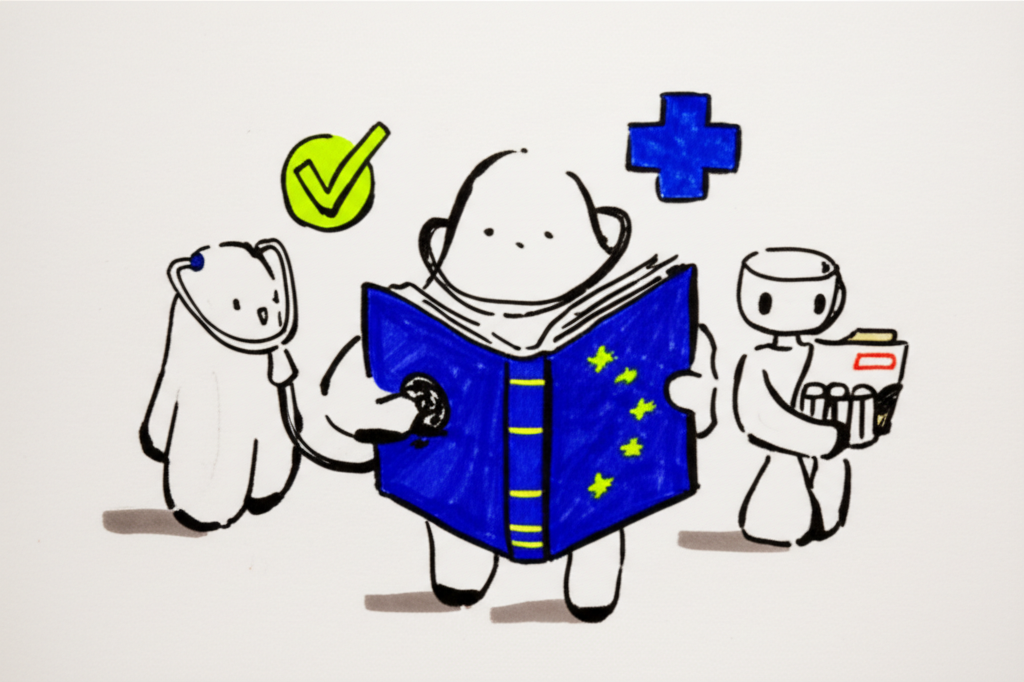
Why the EU AI Act Matters for Healthcare SaaS
The European Union's Artificial Intelligence Act (EU AI Act) is the world's first comprehensive AI regulation framework. While it was formally adopted in March 2024, the high-risk AI provisions that affect most healthcare SaaS providers take full effect on August 2, 2026.
If your platform uses AI to assist with clinical decisions, automate patient triage, score health risks, or generate treatment recommendations, you are almost certainly operating what the Act classifies as a high-risk AI system.
The penalties for non-compliance are severe: up to 35 million euros or 7% of global annual turnover, whichever is higher. But beyond fines, the real risk is market access. Without compliance, you cannot legally deploy AI-powered features to customers operating within the EU.
This guide provides a practical, step-by-step roadmap for healthcare SaaS providers preparing for EU AI Act compliance.
Understanding High-Risk Classification
The EU AI Act uses an annex-based classification system. Annex III explicitly lists healthcare AI systems as high-risk when they are intended for use as:
- Medical device components covered by Regulation (EU) 2017/745
- In-vitro diagnostic components under Regulation (EU) 2017/746
- Safety components of products in the healthcare sector
What This Means in Practice
Consider a typical healthcare SaaS platform that provides:
- AI-assisted patient intake that prioritizes cases by urgency
- Automated report generation summarizing clinical observations
- Risk scoring algorithms that flag patients for follow-up
Under the EU AI Act, all three qualify as high-risk because they influence clinical decision-making. The AI does not need to make the final decision. It only needs to "meaningfully influence" the process.
The "Meaningful Influence" Test
Article 6 of the Act establishes that an AI system is high-risk if it:
- Is intended to be used as a safety component of a product, or is itself a product, covered by EU harmonization legislation listed in Annex I
- The product requires a third-party conformity assessment under that harmonization legislation
For SaaS providers, the critical question is: Does your AI output feed into a decision that affects patient health, safety, or access to care? If yes, you are operating a high-risk system.
The Six Compliance Requirements
High-risk AI systems under the EU AI Act must satisfy six core requirements. Here is how each applies to healthcare SaaS.
1. Risk Management System (Article 9)
You must establish and maintain a continuous risk management process throughout the AI system's lifecycle. This includes:
- Identification of known and foreseeable risks to health and safety
- Estimation and evaluation of risks that may emerge when the system is used as intended or under conditions of reasonably foreseeable misuse
- Adoption of risk mitigation measures, including design choices and technical safeguards
For healthcare SaaS, this means documenting what happens when the AI generates an incorrect recommendation. What safeguards prevent a misclassified patient from being deprioritized? What happens if the training data contains demographic biases?
2. Data Governance (Article 10)
Training, validation, and testing datasets must meet specific quality criteria:
- Relevance and representativeness to the intended deployment context
- Statistical properties appropriate for the geographic, behavioral, and functional settings
- Bias examination and mitigation across protected characteristics
Healthcare SaaS providers face a unique challenge: patient data is subject to both the EU AI Act and GDPR simultaneously. Your data governance framework must address both regulatory frameworks.
3. Technical Documentation (Article 11)
You must maintain detailed technical documentation that demonstrates compliance with all high-risk requirements. The documentation must include:
- A general description of the AI system and its intended purpose
- Detailed information about data training methodologies, datasets used, and data preprocessing
- Design specifications, system architecture, and computational resources
- Descriptions of monitoring, functioning, and control mechanisms
- Validation and testing procedures and results
This is where most healthcare SaaS providers struggle. Technical documentation for AI compliance goes far beyond standard software documentation. It requires traceability from data input to decision output.
4. Record-Keeping (Article 12)
High-risk AI systems must include logging capabilities that allow for:
- Recording of events during operation (automatic logging)
- Traceability of decisions and outputs
- Identification of situations that may require human intervention
For healthcare SaaS, this means every AI-assisted decision must be traceable. When a risk score is generated, you must be able to reconstruct the exact data inputs, model version, and processing steps that produced it.
5. Transparency and Information (Article 13)
Deployers (your healthcare customers) must receive clear instructions that include:
- The AI system's intended purpose, capabilities, and limitations
- Known risks and potential for errors
- Human oversight measures and how to interpret outputs
- Technical specifications for integration and monitoring
Your product documentation must enable healthcare providers to understand and appropriately supervise AI outputs.
6. Human Oversight (Article 14)
High-risk AI systems must be designed to allow effective human oversight. In healthcare, this means:
- Clinicians must be able to override or reverse AI-generated recommendations
- The system must provide sufficient interpretability for informed decision-making
- Automated actions must include intervention mechanisms that allow human operators to stop or modify the system's behavior
This is not optional. "AI-only" clinical workflows without human oversight mechanisms violate the Act regardless of accuracy.
Building a Compliance Roadmap
Based on our experience helping healthcare SaaS providers prepare for compliance, here is a practical timeline.
Phase 1: Assessment (Months 1-2)
- Inventory all AI features and classify them under the EU AI Act risk categories
- Map data flows from ingestion through model inference to user-facing outputs
- Identify gaps between current documentation and Article 11 requirements
- Assess existing logging and traceability mechanisms against Article 12
Phase 2: Technical Implementation (Months 3-5)
- Implement decision proof logging for all high-risk AI pathways
- Build or integrate a conformity assessment documentation system
- Establish automated bias monitoring for training and inference pipelines
- Deploy human oversight interfaces (override buttons, confidence displays, escalation paths)
Phase 3: Documentation and Testing (Months 6-8)
- Complete technical documentation per Annex IV requirements
- Conduct internal conformity assessments
- Run adversarial testing for edge cases and misuse scenarios
- Document risk mitigation measures and their effectiveness
Phase 4: Validation and Maintenance (Ongoing)
- Establish continuous monitoring for model drift and performance degradation
- Create incident response procedures for AI-related safety events
- Build update procedures that maintain documentation currency
- Schedule regular compliance audits
How Decision Proof Units (DPU) Accelerate Compliance
One of the most demanding aspects of EU AI Act compliance is the requirement for traceable, auditable decision records. Every high-risk AI decision must be reconstructible: what data went in, what model processed it, and what recommendation came out.
Cronozen's Decision Proof Unit (DPU) architecture addresses this directly:
- Hash-chain integrity: Every decision record is cryptographically linked to its predecessor, creating an immutable audit trail
- Five-level governance: Policy existence, evidence level, human review, risk threshold, and dual approval checks are enforced at the system level
- Evidence progression: Records move through DRAFT, DOCUMENTED, and AUDIT_READY stages, with locked records that cannot be modified
- JSON-LD export: Decision proofs are exportable in a standardized schema format for regulatory submission
Instead of building custom compliance logging from scratch, healthcare SaaS providers can integrate DPU to meet Articles 11, 12, and 14 simultaneously.
What Happens If You Are Not Ready?
The EU AI Act's enforcement timeline is not negotiable. After August 2, 2026:
- Market surveillance authorities can request documentation at any time
- Deployers (your customers) are legally required to ensure the AI systems they use comply
- Serious incidents involving high-risk AI must be reported within specific timeframes
Healthcare organizations that are your customers will increasingly require proof of EU AI Act compliance as a procurement condition. Being ahead of compliance is a competitive advantage.
Next Steps
- Audit your AI features: Determine which features qualify as high-risk under Annex III
- Assess documentation gaps: Compare your current technical docs against Article 11 requirements
- Evaluate decision traceability: Can you reconstruct any AI-assisted decision from input to output?
- Plan your implementation: Use the phased roadmap above to allocate resources
The EU AI Act is not just a regulatory burden. It is an opportunity to differentiate your healthcare SaaS with verifiable AI governance. Providers who demonstrate compliance earn trust, and trust drives adoption.
Ready to build auditable AI governance into your healthcare platform? Book a Demo to see how Cronozen's DPU framework can accelerate your EU AI Act compliance.