
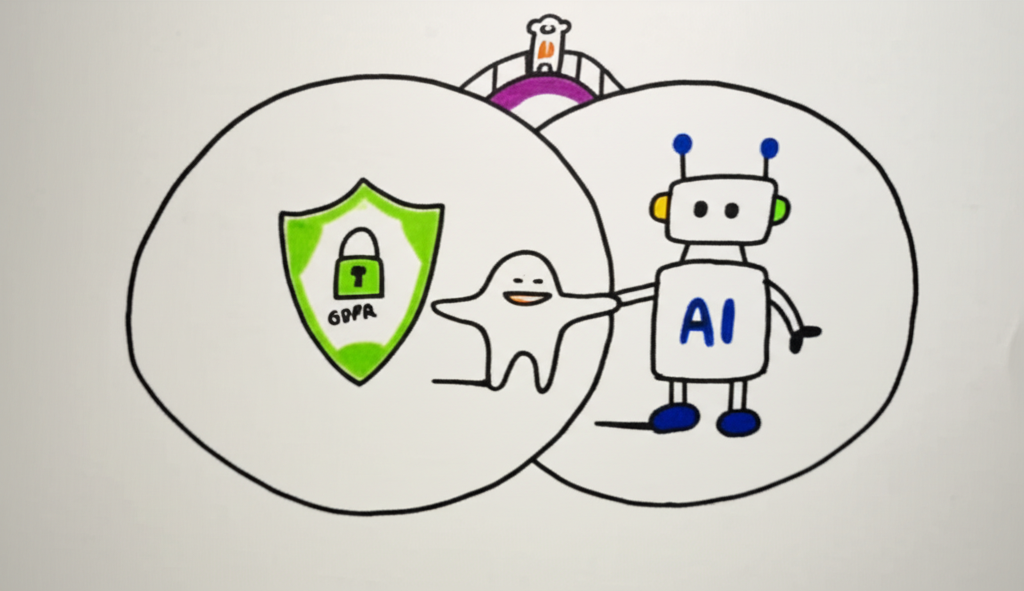
Two Regulations, One Platform
If your platform uses AI to process personal data within the European Union, you are subject to two major regulatory frameworks simultaneously:
- GDPR (General Data Protection Regulation) — governs how personal data is collected, processed, stored, and shared
- EU AI Act — governs how AI systems are designed, deployed, monitored, and documented
These are not independent requirements. They overlap significantly, and the intersection creates both challenges and opportunities. Organizations that treat them as separate compliance workstreams end up with duplicated effort, inconsistent documentation, and gaps where the two frameworks interact.
This guide explains where GDPR and the EU AI Act overlap, where they diverge, and how to build a unified compliance platform that addresses both.
Where the Regulations Overlap
Automated Decision-Making
GDPR Article 22 gives individuals the right not to be subject to decisions based solely on automated processing that produce legal effects or similarly significantly affect them. The EU AI Act's high-risk requirements (Article 14) mandate human oversight for AI systems that influence significant decisions.
The overlap: Both regulations require human involvement in consequential AI decisions. But GDPR focuses on the individual's right to contest automated decisions, while the EU AI Act focuses on the system's design requirements for human oversight.
Practical implication: Your platform must both (a) provide human oversight mechanisms as required by the EU AI Act and (b) provide individuals with the right to contest those decisions as required by GDPR.
Transparency Requirements
GDPR Articles 13-14 require informing data subjects about the existence of automated decision-making and providing "meaningful information about the logic involved." The EU AI Act Article 13 requires that high-risk AI systems be transparent enough for deployers to interpret outputs and use them appropriately.
The overlap: Both require transparency about how AI processes data and reaches conclusions. But GDPR's transparency is directed at data subjects (individuals), while the EU AI Act's transparency is directed at deployers (organizations using the AI system).
Practical implication: You need two layers of transparency — one for end users explaining how their data influences AI decisions, and one for your business customers explaining how to interpret and supervise AI outputs.
Data Quality
GDPR Article 5(1)(d) requires that personal data be accurate and kept up to date. The EU AI Act Article 10 requires that training and validation datasets meet quality criteria including accuracy, representativeness, and freedom from errors.
The overlap: Both demand high-quality data. But GDPR focuses on the accuracy of individual records, while the EU AI Act focuses on the quality of datasets as a whole (statistical properties, representativeness, bias).
Practical implication: Your data quality framework must address both individual record accuracy (GDPR) and dataset-level statistical properties (EU AI Act).
Where the Regulations Diverge
Data Minimization vs. Data Documentation
GDPR's data minimization principle (Article 5(1)(c)) requires processing only the personal data that is necessary for the specified purpose. The EU AI Act's documentation requirements (Article 11) require maintaining detailed records of training data, including descriptions of datasets and their properties.
The tension: GDPR says minimize data collection. The EU AI Act says document your data thoroughly. These are not contradictory, but they require careful navigation.
Resolution: Collect and process only the data you need (GDPR), but thoroughly document what you collect, why you collect it, and how you use it (EU AI Act). Data minimization does not mean documentation minimization.
Right to Erasure vs. Audit Trails
GDPR Article 17 gives individuals the right to have their personal data erased ("right to be forgotten"). The EU AI Act Articles 12 and 19 require maintaining logs and records for the AI system's operational lifetime, which may extend well beyond any individual's relationship with the platform.
The tension: An individual may request data deletion, but regulatory audit requirements demand that decision records be preserved.
Resolution: Implement pseudonymization and data separation. Decision proof records (DPU) can retain the decision context, governance checks, and model behavior without retaining the personal data that identified the individual. When an erasure request is processed, the personal identifiers are removed but the anonymized decision record remains available for audit purposes.
Consent Models
GDPR provides six legal bases for processing personal data, with consent being the most commonly used for AI processing. The EU AI Act does not directly address consent but requires that deployers inform individuals when they are interacting with an AI system and when AI is used for emotion recognition or biometric categorization.
The gap: GDPR consent covers data processing. But there is no explicit "consent to AI processing" mechanism in current law. However, the combination of GDPR's informed consent requirements and the EU AI Act's transparency requirements effectively creates one.
Resolution: Extend your consent mechanisms to explicitly cover AI processing. When obtaining consent for data processing, include clear information about which AI systems will process the data, what decisions they will influence, and how the individual can exercise their rights.
Building a Unified Compliance Platform
Architecture: The Compliance Stack
A unified GDPR + EU AI Act compliance platform requires four integrated layers:
Layer 1: Data Governance Foundation
- Data inventory and classification (personal data, sensitive data, AI training data)
- Purpose limitation enforcement (data can only flow to authorized processing activities)
- Retention policies aligned with both GDPR requirements and EU AI Act audit needs
- Automated data subject request handling (access, rectification, erasure, portability)
Layer 2: AI System Registry
- Catalog of all AI systems with risk classifications
- Model version tracking with deployment history
- Training data provenance linking to data governance records
- Performance monitoring (accuracy, drift, bias metrics)
Layer 3: Decision Proof Layer
- DPU integration for all high-risk AI decision points
- Hash-chain integrity for audit trail immutability
- Pseudonymization at the decision record level
- Evidence level progression (DRAFT → DOCUMENTED → AUDIT_READY)
Layer 4: Governance Automation
- Automated DPIA (Data Protection Impact Assessment) triggers
- Continuous conformity assessment for EU AI Act requirements
- Cross-regulation gap analysis and alerting
- Regulatory reporting generation (both GDPR and EU AI Act formats)
Practical Implementation Steps
Step 1: Unified Data Mapping
Create a single data map that shows:
- What personal data you collect (GDPR requirement)
- How that data flows to AI systems (EU AI Act requirement)
- What decisions the AI makes using that data (both regulations)
- Where decision records are stored and for how long (both regulations)
This is not two separate exercises. It is one comprehensive data flow map with annotations for both regulatory frameworks.
Step 2: Integrated Impact Assessments
GDPR requires Data Protection Impact Assessments (DPIA) for high-risk processing. The EU AI Act requires conformity assessments for high-risk AI systems. Rather than conducting these separately:
- Trigger a combined assessment when a new AI feature processes personal data
- Evaluate data protection impact and AI risk simultaneously
- Document both assessments in a unified format
- Review and update on the same schedule
Step 3: Unified Consent and Transparency
Build a consent and information framework that addresses both regulations:
- Pre-processing: Inform users about data collection (GDPR) and AI system interaction (EU AI Act)
- During processing: Display AI confidence levels (EU AI Act) and data usage indicators (GDPR)
- Post-processing: Provide decision explanations (EU AI Act) and data access (GDPR)
Step 4: Decision Proof with Privacy
Configure DPU to capture decision context while respecting data minimization:
- Record the decision, governance checks, and model behavior in full
- Pseudonymize personal identifiers at the record level
- Maintain the ability to re-link records when the data subject exercises access rights
- Permanently anonymize records when erasure rights are exercised, preserving audit capability
The Cost of Separate Compliance
Organizations that maintain separate GDPR and EU AI Act compliance programs typically experience:
- 2-3x documentation overhead: Two separate documentation systems covering overlapping requirements
- Inconsistent risk assessments: GDPR DPIAs and EU AI Act conformity assessments reaching different conclusions about the same system
- Compliance gaps at the intersection: Neither team owns the overlap between data protection and AI governance
- Duplicated tooling costs: Separate consent management, audit logging, and monitoring systems
A unified approach eliminates these inefficiencies. One data map, one impact assessment process, one audit trail, one monitoring dashboard.
How Cronozen Addresses Both Regulations
Cronozen's platform architecture was designed from the ground up to address the GDPR and EU AI Act intersection:
- DPU hash chains satisfy both GDPR's accountability principle (Article 5(2)) and the EU AI Act's record-keeping requirements (Article 12)
- Five-level governance maps to both GDPR's data protection by design principle and the EU AI Act's risk management requirements
- Evidence progression (DRAFT → DOCUMENTED → AUDIT_READY) provides the documentation lifecycle required by both frameworks
- JSON-LD export generates regulatory submissions in formats compatible with both DPA (Data Protection Authority) and market surveillance authority requirements
The key design decision is that privacy and AI governance are not separate features. They are properties of the same decision proof architecture.
Action Items
If your platform processes personal data through AI systems in the EU, start with these steps:
- Map the overlap: Identify where your GDPR and AI governance requirements address the same systems and data flows
- Consolidate assessments: Combine DPIAs and AI conformity assessments into a unified process
- Implement privacy-preserving decision proofs: Ensure your AI audit trail respects data minimization and erasure rights
- Unify monitoring: Build one dashboard that tracks both data protection and AI governance metrics
The August 2026 deadline for EU AI Act compliance is approaching. Organizations that have already invested in GDPR compliance have a significant head start — but only if they recognize and leverage the overlap.
Need a platform that handles GDPR and EU AI Act compliance together? Book a Demo to see how Cronozen's unified governance architecture can simplify your compliance journey.