
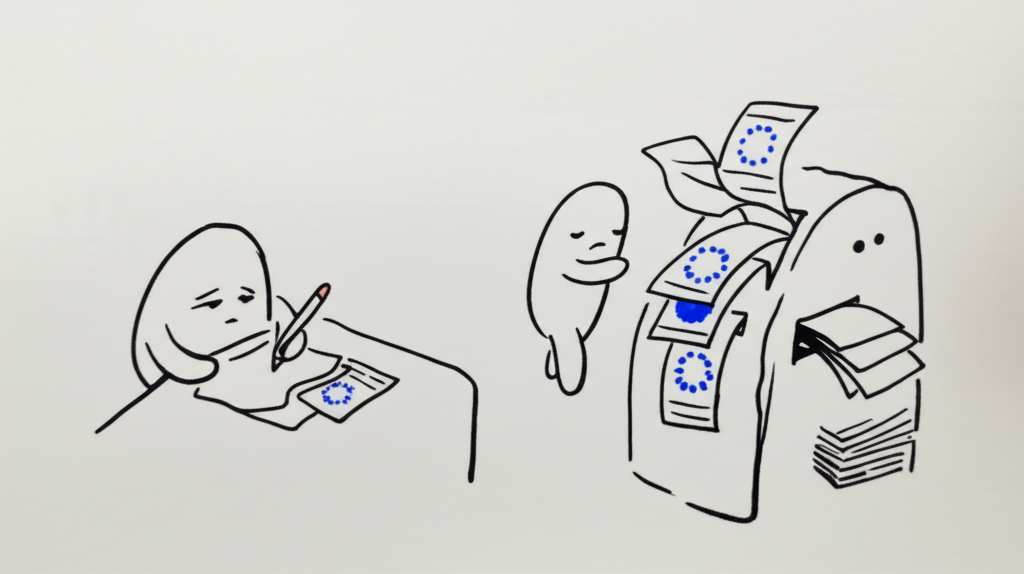
The Documentation Problem No One Wants to Talk About
Every organization deploying high-risk AI in the European Union faces the same uncomfortable reality: Article 11 of the EU AI Act requires comprehensive technical documentation before the system enters the market. And "comprehensive" is not a euphemism. Annex IV of the Act specifies exactly what must be documented, and the list is extensive.
Most compliance teams discover the scope of this requirement and immediately reach for the familiar tools: Word documents, spreadsheet trackers, shared drives. They assign engineers to write up model descriptions. They ask data scientists to catalog training datasets. They create Confluence pages for system architecture diagrams.
Six weeks later, they have a documentation package that was already outdated the day it was completed.
This is not a failure of effort. It is a failure of approach. AI systems are not static. Models are retrained. Datasets are updated. Hyperparameters are tuned. Decision boundaries shift. Any documentation strategy that treats AI technical documentation as a point-in-time artifact is fundamentally incompatible with how modern AI systems actually operate.
What Article 11 and Annex IV Actually Require
Before discussing automation, it is important to understand exactly what the EU AI Act demands. Article 11 establishes the obligation. Annex IV specifies the content.
The Eight Documentation Categories
Annex IV requires the following for every high-risk AI system:
1. General System Description
- The intended purpose of the AI system
- The name and version of the system
- How the AI system interacts with hardware and software that is not part of the system itself
- The versions of relevant software or firmware and any requirement related to version update
2. Detailed System Information
- The development methodology and techniques used to build the system
- The design specifications, including the general logic and algorithms
- The key design choices, including rationale and assumptions
- The system architecture explaining how software components build on or feed into each other
3. Training Data Documentation
- Descriptions of training, validation, and testing datasets
- Data origin, scope, and key characteristics
- How data was obtained and selected
- Labeling procedures, data cleaning methodologies, and data enrichment techniques
- Relevance, representativeness, and known limitations of the data
4. Training Methodology
- The training methodologies and techniques used
- The training computations and resources required
- Hyperparameter choices and optimization criteria
- Methods and metrics used to evaluate performance
5. Performance Metrics and Testing
- Validation and testing procedures and results
- Performance metrics for different demographic groups where relevant
- Known limitations and foreseeable unintended outcomes
- Risk mitigation measures adopted
6. Post-Market Monitoring
- Descriptions of monitoring, functioning, and control mechanisms
- Technical specifications for performance monitoring over time
- Alert thresholds and escalation procedures
7. Interaction with Other Systems
- Technical measures to facilitate interpretation of outputs by deployers
- Specifications for input data formats and expected outputs
- Interface documentation for human oversight mechanisms
8. Quality Management
- Conformity assessment procedures
- Record-keeping and traceability mechanisms
- Corrective action procedures when issues are identified
This is not optional. It is not a suggestion. It is a legal requirement with penalties of up to 15 million euros or 3% of global annual turnover for non-compliance.
Why Manual AI Technical Documentation Fails
Organizations that attempt to document AI systems manually encounter the same failure patterns repeatedly.
Failure 1: The 40-Hour Problem
A single comprehensive documentation package for one AI system takes an estimated 40 to 80 hours of engineering and compliance team time. This estimate comes from organizations that participated in the EU AI Act regulatory sandbox and attempted to produce Annex IV-compliant documentation.
For a platform with five AI features, that is 200 to 400 hours of effort. And that is just the initial documentation, not ongoing maintenance.
Failure 2: Instant Obsolescence
The moment documentation is completed, it begins to decay. A model retrained on Tuesday invalidates the training methodology description written on Monday. A dataset updated with new records changes the statistical properties documented last month. A hyperparameter adjustment changes the performance metrics.
Manual documentation creates a snapshot of a system that no longer exists.
Failure 3: No Version Alignment
When documentation is maintained separately from the system it describes, version alignment becomes impossible. Which version of the documentation corresponds to which version of the model? Did the data documentation get updated when the training pipeline was modified? Is the performance metrics section describing the current production model or the one that was replaced three weeks ago?
Without tight coupling between the AI system and its documentation, regulators cannot trust that the documents reflect reality.
Failure 4: The Knowledge Silo
The engineer who designed the model architecture is not the same person who curated the training data. The data scientist who selected hyperparameters is not the same person who measured performance metrics. The compliance officer who structures the documentation does not understand the technical decisions well enough to document their rationale.
Manual documentation requires assembling knowledge from multiple individuals who each hold partial understanding. Critical context is lost in translation.
Failure 5: No Integrity Guarantee
A Word document can be edited at any time. A spreadsheet can be modified without trace. A Confluence page can be updated and the edit history quietly overridden. When a regulator requests documentation, how do you prove that the documents were created contemporaneously with the system they describe, rather than assembled retroactively after an audit request?
Manual documentation has no inherent integrity guarantee.
What Automated AI Technical Documentation Looks Like
Automated documentation generation does not mean pressing a button to produce a PDF. It means building documentation capture into the AI system's operational pipeline so that documentation is a byproduct of the system's normal functioning.
Principle 1: Capture at the Source
Every component of the AI pipeline should emit documentation artifacts as it operates:
- Training pipelines record dataset versions, preprocessing steps, hyperparameters, and training metrics automatically
- Model registries capture architecture descriptions, version histories, and deployment records
- Inference engines log input characteristics, model behavior, output distributions, and confidence metrics
- Governance layers record approval decisions, human review actions, and policy check results
None of this requires engineers to stop and write descriptions. The system documents itself.
Principle 2: Continuous Assembly
Rather than producing documentation as a periodic project, automated systems continuously assemble documentation from captured artifacts. At any point in time, the current state of the documentation reflects the current state of the system.
This means:
- The training data description always reflects the dataset currently in use
- Performance metrics always reflect the production model's actual behavior
- System architecture descriptions always match the deployed configuration
- Risk mitigation measures always align with the governance policies currently enforced
Principle 3: Version Coherence
Automated documentation maintains strict version alignment between the system and its documentation. Every model version has a corresponding documentation version. Every dataset update triggers a documentation update. Every configuration change is reflected in the documentation without human intervention.
When a regulator asks for the documentation for "the model that was running on March 15," the system can produce exactly that, not an approximation assembled from memory.
Principle 4: Tamper-Evidence
Automated documentation systems can embed integrity verification mechanisms that manual documentation cannot. Cryptographic hashing, append-only storage, and chain-of-custody records provide evidence that documentation was generated by the system it describes, at the time it claims to have been generated.
This transforms documentation from a trust-based artifact ("we wrote this last month") to a verification-based artifact ("the cryptographic chain proves this was generated at this timestamp").
The Four-Layer Documentation Architecture
An effective automated documentation system requires four integrated layers.
Layer 1: Artifact Emission
Every component of the AI system emits structured documentation artifacts. A training run produces a training artifact containing dataset identifiers, hyperparameters, compute resources used, and resulting metrics. An inference call produces a decision artifact containing input characteristics, model version, output, and confidence score. A governance check produces an approval artifact containing the policy evaluated, the evidence considered, and the outcome.
These artifacts are machine-readable, timestamped, and immutable once emitted.
Layer 2: Artifact Aggregation
A documentation engine collects artifacts from all sources and assembles them into the eight Annex IV categories. The engine maintains a continuous mapping between artifacts and documentation sections. When a new training artifact arrives, the engine updates the training methodology section. When new performance metrics are recorded, the engine updates the testing section.
This aggregation happens automatically and continuously.
Layer 3: Regulatory Formatting
Aggregated documentation must be presented in formats that regulators can consume. This layer transforms the aggregated artifacts into structured documents, whether PDF reports for human review, machine-readable formats for automated regulatory systems, or standardized schemas for cross-border compliance.
The key requirement is that the formatting layer does not lose information. The regulatory document must be traceable back to the underlying artifacts.
Layer 4: Integrity Verification
The final layer provides cryptographic proof that the documentation chain is intact. Each artifact is hashed. Hashes are chained sequentially. The chain can be verified at any point to confirm that no artifact has been modified, removed, or inserted out of sequence.
This layer answers the regulator's fundamental question: "Can I trust this documentation?"
Practical Implementation Considerations
Starting from Where You Are
Most organizations are not building from scratch. They have existing AI systems with existing (if incomplete) documentation. The path to automation begins with:
Instrumentation: Add artifact emission to existing training pipelines and inference services. This does not require rewriting the AI system. It requires adding structured logging at key points.
Schema definition: Define the artifact formats for your specific AI systems. What information must each training run emit? What must each inference call record? What governance checks must be documented?
Aggregation pipeline: Build or adopt a system that collects artifacts and maps them to Annex IV sections. This can start simple and grow in sophistication.
Integrity layer: Implement hash chaining for documentation artifacts. This is the most critical differentiator between automated documentation and automated report generation.
Common Mistakes to Avoid
Mistake: Treating documentation automation as a reporting project. Generating pretty reports from existing data is not the same as capturing documentation at the source. If the underlying data is incomplete, the reports will be too.
Mistake: Automating only the format, not the capture. Converting manual documentation to automated PDF generation solves the wrong problem. The issue is not how documentation looks. The issue is whether it is complete, current, and verifiable.
Mistake: Ignoring the governance layer. Technical documentation without governance documentation is incomplete. Regulators want to see not just what the system does, but how decisions about the system are made and controlled.
How Cronozen Automates AI Technical Documentation
Cronozen's Decision Proof Unit (DPU) was built to solve the documentation problem at its root. Rather than generating documentation as an afterthought, DPU captures decision context as AI systems operate.
- Automatic artifact capture: Every AI decision processed through DPU generates a structured record containing input context, model behavior, governance checks, and output with confidence scores. No manual documentation required.
- SHA-256 hash chains: Every documentation artifact is cryptographically hashed and chained to its predecessor. The chain provides tamper-evident proof that documentation was generated at the claimed time and has not been modified.
- Five-level governance integration: Documentation automatically includes governance proof — policy existence verification, evidence level checks, human review records, risk threshold evaluations, and dual approval confirmations.
- Evidence progression: Documentation moves through DRAFT, DOCUMENTED, and AUDIT_READY stages. Once a record reaches AUDIT_READY, it is locked. Any modification breaks the chain, providing visible evidence of tampering.
- JSON-LD v2 export: All documentation is exportable in a standardized
schema.cronozen.com/decision-proof/v2format. This structured format maps directly to Annex IV requirements and is machine-readable for automated regulatory review.
The result is that organizations using DPU have continuously current, cryptographically verifiable technical documentation that maps directly to EU AI Act requirements, generated automatically as their AI systems operate.
Ready to automate your EU AI Act technical documentation? Book a Demo to see how Cronozen's DPU generates regulatory-ready documentation as your AI systems run.