
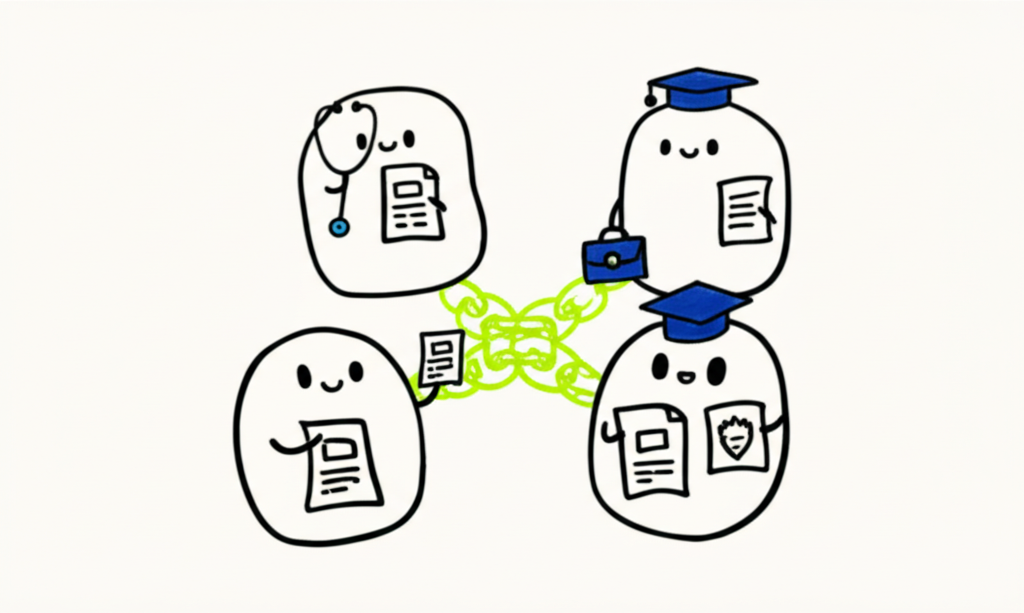
Regulated Industries Are Adopting AI Faster Than They Are Building Accountability
The numbers tell a story of acceleration without guardrails. McKinsey's 2024 Global Survey found 72% of organizations now use AI in at least one business function, up from 20% in 2017. The WHO documented over 500 AI-based medical devices cleared in the United States. The Bank for International Settlements reported 56% of financial institutions deploying AI in customer-facing decisions. Stanford HAI found 45 of 50 U.S. state governments running active AI deployments.
Each of these systems makes decisions affecting individual lives. A diagnostic AI flags -- or misses -- a tumor. A credit model determines whether a family can buy a home. A benefits system grants or withholds welfare support. An assessment algorithm shapes a student's academic trajectory.
The accountability question for these systems is not "does the model perform well on test data?" It is "when this model makes a specific decision about a specific person, can you prove that appropriate governance was applied, that the right humans were involved, and that the decision process was sound?" And across regulated industries, the honest answer from most organizations is: no.
The Risk: "The Model Was Trained on Good Data" Is Not an Acceptable Answer
When an AI system makes a consequential error in a regulated industry, the post-incident investigation inevitably reveals a gap between what the organization can say about the model and what it can prove about the decision.
The Pattern of Accountability Failure
The pattern repeats across industries. An adverse event occurs -- a missed diagnosis, a wrongful denial, a biased outcome. The organization presents its model documentation: training data composition, validation metrics, fairness assessments, architecture decisions. This documentation may be thorough and genuine. But it addresses the wrong question.
The investigation asks: "For this specific patient, this specific applicant, this specific claimant -- what happened?" Not what the model generally does, but what it specifically did. What data was used as input. What preprocessing was applied. What the model's raw output was. What governance policies applied to that output. Whether human review was required and performed. Whether the reviewer was qualified. Whether the decision was delivered to the affected individual. Whether any of this was altered after the fact.
This is the accountability gap: the distance between "we built a good model" and "we can prove this specific decision was made with appropriate governance." And it exists because accountability in regulated industries is not a model-level concern -- it is a decision-level concern.
Why Software QA Methods Do Not Transfer
Most organizations have attempted to address AI accountability by extending their existing software quality assurance practices. They apply the same tools and methods they use for traditional software: unit testing, integration testing, monitoring, alerting, incident response. These are valuable practices, but they were designed for deterministic systems with predictable behavior.
AI systems are fundamentally different. A model's behavior depends on training data, architecture, hyperparameters, and production input distributions. It can perform flawlessly in testing and fail in production when it encounters unfamiliar data distributions.
More importantly, software QA focuses on correctness -- does the system produce the right output? AI accountability focuses on governance -- was the right process followed regardless of the output? A model can produce a correct prediction while violating governance requirements. Conversely, it can produce an incorrect prediction while following governance perfectly -- and from a compliance perspective, that is acceptable, because accountability is about process, not perfection.
Industry-Specific Accountability Requirements
While the underlying principle of AI accountability is consistent across industries -- prove that appropriate governance was applied to each decision -- the specific requirements vary significantly by domain. Each regulated industry has its own regulatory framework, its own risk profile, and its own definition of what "appropriate governance" means.
Healthcare: Patient Safety and Clinical Evidence
Healthcare AI accountability is governed by a complex web of regulations that vary by jurisdiction but share common themes: patient safety, clinical evidence, and professional responsibility.
Regulatory framework. In the United States, the FDA's framework for AI/ML-based Software as a Medical Device (SaMD) requires a "predetermined change control plan" that documents how AI systems will be monitored and updated. The EU's Medical Device Regulation (MDR) requires clinical evidence for AI-based medical devices and ongoing post-market surveillance. South Korea's Ministry of Food and Drug Safety has established AI medical device guidance requiring validation of algorithm performance across demographic groups.
Accountability requirements specific to healthcare:
- Clinical validation records: For each AI-assisted clinical decision, evidence that the algorithm was operating within its validated scope (correct patient population, correct imaging modality, correct clinical context)
- Practitioner oversight documentation: Proof that a qualified healthcare professional reviewed the AI output before it influenced patient care, with records of the practitioner's identity, qualifications, and assessment
- Patient safety thresholds: Evidence that risk thresholds were applied and enforced -- for example, that a diagnostic AI's confidence score was above the minimum threshold required for the clinical context, or that cases below the threshold were automatically escalated
- Adverse event linkage: The ability to trace from a patient safety event backward through the complete decision chain to the original AI output, governance checks, and input data
The accountability challenge in healthcare is that errors can cause irreversible harm. A missed diagnosis cannot be un-missed. This makes retrospective reconstruction insufficient -- governance must be verified in real time, at the point of decision.
Finance: Fair Lending and Algorithmic Transparency
Financial services AI accountability is driven by decades of anti-discrimination law, consumer protection regulation, and prudential supervision.
Regulatory framework. In the United States, the Equal Credit Opportunity Act (ECOA) and Fair Housing Act require that lending decisions be free from discrimination, and the Consumer Financial Protection Bureau (CFPB) has issued guidance specifically addressing AI-driven adverse action notices. The EU AI Act classifies creditworthiness assessment as high-risk. The Bank of England's Prudential Regulation Authority has issued supervisory expectations for AI in financial services. Basel III's operational risk framework increasingly encompasses AI-related risks.
Accountability requirements specific to finance:
- Adverse action documentation: For every denied credit application, a complete record of the factors that contributed to the denial, the model version that produced the assessment, and the governance policies that were applied
- Fair lending analysis: Evidence that the model's decisions were tested for disparate impact across protected classes, with records of when these analyses were performed, what results they produced, and what remediation was applied
- Model risk management: Proof of compliance with OCC Bulletin 2011-12 (SR 11-7) model risk management requirements, including model validation, ongoing monitoring, and governance committee oversight
- Explainability for consumers: Beyond regulatory compliance, financial institutions must provide affected individuals with understandable reasons for adverse decisions -- a requirement that goes beyond XAI's technical explanations to human-readable, legally compliant adverse action notices
The accountability challenge in finance is that AI decisions have immediate economic consequences and are subject to both regulatory examination and private litigation. A single decision can trigger a fair lending complaint, a regulatory investigation, or a class action lawsuit. Each of these requires decision-level evidence, not model-level documentation.
Public Sector: Equity and Due Process
Public sector AI accountability carries unique weight because government decisions affect fundamental rights and cannot be avoided by the affected individuals -- you cannot choose a different government the way you can choose a different bank.
Regulatory framework. The EU AI Act classifies AI used in "access to and enjoyment of essential private services and essential public services and benefits" as high-risk. The White House Executive Order on AI (14110) requires federal agencies to conduct AI impact assessments and establish AI governance structures. Canada's Algorithmic Impact Assessment Tool is mandatory for federal government AI deployments. The UK's Algorithmic Transparency Recording Standard requires public sector organizations to document their use of algorithmic decision-making.
Accountability requirements specific to public sector:
- Due process documentation: Evidence that AI-assisted decisions affecting individual rights included appropriate review mechanisms, appeal processes, and human oversight
- Equity analysis: Proof that AI systems were evaluated for discriminatory impact across demographic groups, with particular attention to historically disadvantaged populations
- Transparency records: Documentation of what AI systems are in use, what decisions they influence, and how affected individuals can seek review -- often required to be proactively published
- Democratic accountability: Evidence that elected officials and appointed oversight bodies were informed of AI deployments and their impacts, creating a governance chain that connects technical decisions to democratic authority
The accountability challenge in public sector is the intersection of technical governance with democratic governance. It is not sufficient to prove that the system followed its technical policies. You must also prove that those policies were authorized by the appropriate institutional authority and that affected individuals had recourse.
Education: Student Data Protection and Developmental Impact
Educational AI accountability is an emerging but rapidly developing area, driven by concerns about student privacy, developmental impact, and educational equity.
Regulatory framework. FERPA and COPPA govern student data in the United States. The EU's GDPR applies heightened protections to children's data. UNESCO's AI Ethics Recommendation specifically addresses educational AI, calling for "ensuring inclusivity and equity" in AI-assisted decisions.
Accountability requirements specific to education:
- Student data governance: Evidence that AI systems processing student data comply with applicable privacy regulations, with records of what data was used, how consent was obtained, and how data minimization principles were applied
- Developmental appropriateness: Proof that AI-driven educational assessments and recommendations were validated for the specific age groups and developmental stages of the students they affect
- Equity monitoring: Evidence that AI systems do not perpetuate or amplify educational inequities based on socioeconomic status, race, disability, or other protected characteristics
- Parental and guardian access: Records demonstrating that parents and guardians can access information about how AI systems affect their children's educational experience, including the ability to review and challenge AI-driven decisions
The Common Thread: Provable Governance
Across healthcare, finance, public sector, and education, the accountability requirements share a common structure despite their domain-specific details. In every case, regulators need evidence of four things:
- That governance policies existed and were appropriate for the domain and risk level
- That those policies were actually applied to each individual decision, not just documented in a policy manual
- That humans were involved at the appropriate points in the decision process, with documented qualifications and assessments
- That the evidence of all of the above is authentic -- captured at the time of the decision, preserved without alteration, and independently verifiable
This is what "provable governance" means. Not governance as a document. Governance as a verifiable, tamper-proof record that can withstand regulatory scrutiny, legal challenge, and public accountability.
Building Accountability Infrastructure That Works Across Domains
The cross-domain nature of AI accountability creates both a challenge and an opportunity. Each industry has specific requirements, but the underlying infrastructure -- decision capture, governance verification, integrity proof, regulatory export -- is consistent across all of them.
This suggests a two-layer architecture: a domain-independent proof engine handling cryptographic and governance mechanics, and domain-specific governance policies encoding each industry's particular requirements. The proof engine answers universal questions (how to capture, verify, seal, and export decisions). The policies answer domain questions (what governance applies, what thresholds trigger review, who is qualified). Different answers per industry -- same enforcement mechanism.
How Cronozen Delivers Verifiable Accountability Across Regulated Industries
Cronozen's architecture was designed around precisely this two-layer model. The Decision Proof Unit (DPU) is a domain-independent cryptographic proof engine that provides the infrastructure for decision capture, governance verification, and integrity proof. On top of the DPU, Cronozen provides domain-specific governance policies across 16 regulated domains, including healthcare, financial services, education, public sector, and welfare.
Each domain's governance policies encode the specific accountability requirements of that industry. For healthcare, this includes clinical validation thresholds, practitioner oversight requirements, and patient safety escalation rules. For finance, this includes fair lending analysis triggers, adverse action documentation requirements, and model risk management controls. For public sector, this includes equity analysis checkpoints, due process verification, and democratic accountability chains.
Cronozen's five-level governance framework provides the enforcement mechanism:
- Level 1 -- Policy Existence: Verifies that an appropriate governance policy covers the decision type and domain
- Level 2 -- Evidence Level: Ensures that sufficient evidence has been collected, progressing through DRAFT, DOCUMENTED, and AUDIT_READY maturity stages
- Level 3 -- Human Review: Enforces human oversight requirements and records reviewer identity, qualifications, timing, and assessment
- Level 4 -- Risk Threshold: Evaluates the decision's risk level against domain-specific thresholds and triggers additional controls when thresholds are exceeded
- Level 5 -- Dual Approval: For the highest-risk decisions, requires independent confirmation from a second qualified approver
Every governance evaluation is sealed into a SHA-256 hash chain -- each record linked to its predecessor through computeChainHash(content, previousHash, timestamp) -- creating an append-only audit trail where any modification to any historical record is mathematically detectable. The chain begins with a Genesis record and extends continuously, providing cryptographic proof of the complete governance history.
For regulatory export, Cronozen produces JSON-LD v2 structured data conforming to published schemas, giving auditors in any industry machine-readable evidence they can independently verify. Whether the auditor is an FDA inspector reviewing a medical AI deployment, a banking examiner evaluating a credit model, or a government oversight body assessing a public benefits system, the evidence format is standardized, structured, and verifiable.
The result is AI model accountability that is not a set of documents claiming governance was applied, but a cryptographic proof chain demonstrating it -- decision by decision, across every regulated domain.
See how verifiable accountability works in your industry. Book a Demo to explore Cronozen's domain-specific governance policies and Decision Proof Unit for your regulatory environment.